
IMPORTANT NOTE: Temazcal is a voluntary activity at Oceánica; participation is never required. Certain medical conditions may contraindicate participation — the clinical team assesses individual suitability. This article is informational and not medical advice.
Among the distinctive features of treatment in Mexico — and one that distinguishes Oceánica from treatment programs in the United States — is the temazcal: a traditional pre-Hispanic sweat lodge ceremony rooted in Mesoamerican indigenous culture. The temazcal is not a Western wellness trend or a metaphor — it is an ancient ceremonial practice with deep cultural roots in Mexico, and at Oceánica it is offered as a voluntary element of the recovery experience that some patients find profoundly meaningful.
This article explains what temazcal is, its pre-Hispanic origins, its physiological and psychological effects, how it fits within a recovery context, and what first-time participants can expect.
WHAT TEMAZCAL IS
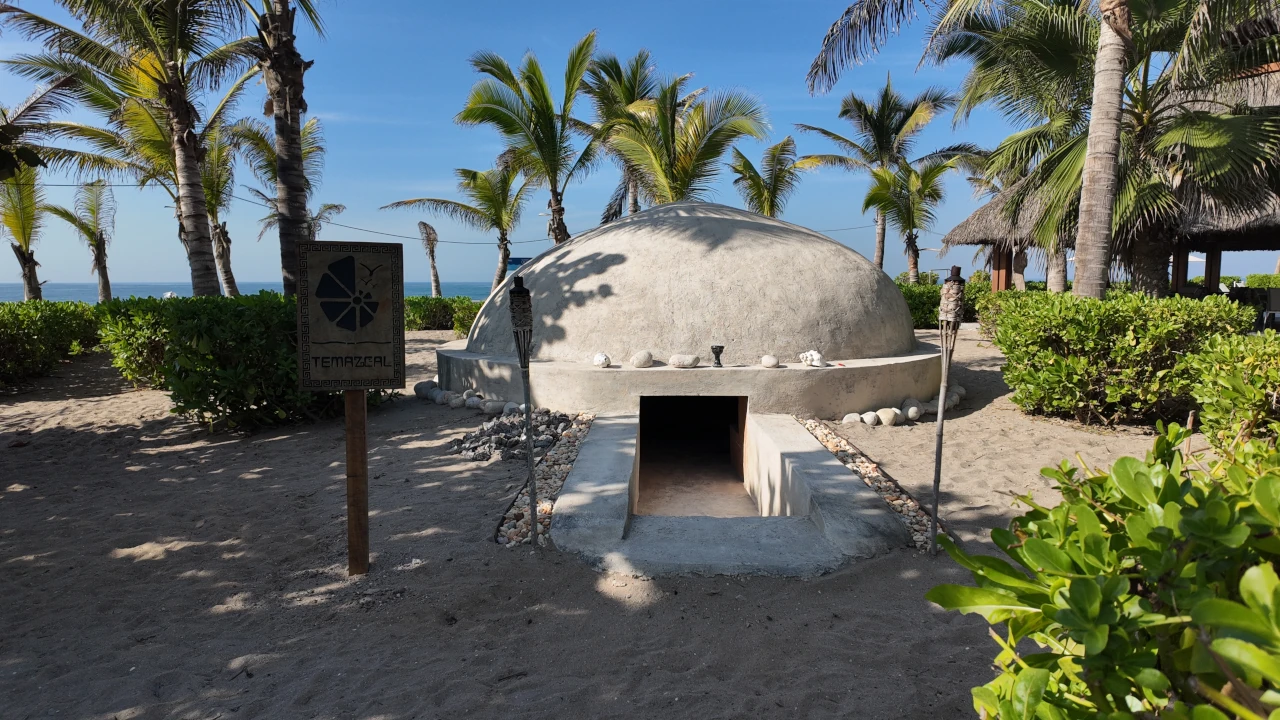
Temazcal (from Nahuatl: temazcalli — “house of heat”) is a traditional closed chamber sweat lodge used for ceremonial purification, healing, and communal ritual, originating with the indigenous peoples of Mesoamerica — particularly the Aztec (Mexica), Maya, and other pre-Hispanic cultures of what is now Mexico.
The physical structure is typically a dome-shaped chamber, often built from stone, adobe, or other earth materials, with a low entrance that requires entering bent or crawling — a gesture sometimes interpreted symbolically as entering a womb or a space of transformation. Volcanic rocks are heated outside and brought inside; water infused with medicinal herbs is poured over the rocks, generating intense steam and heat.
At Oceánica, the temazcal is facilitated by a trained guide who leads the ceremony with traditional elements appropriate to the context — often including:
- Invocations or intention-setting appropriate to recovery (gratitude, release, healing)
- Use of aromatic and medicinal herbs (often including copal, eucalyptus, and others with cultural and physiological significance)
- Guided breathing and body awareness through the heat
- Periods of stillness and reflection interspersed with guided attention
The ceremony typically lasts from 30 to 90 minutes, with the participants emerging renewed and having typically sweated extensively. A cooling shower or pool access follows.
Participation is entirely voluntary. No patient is required to participate in temazcal, and those who choose not to participate are not disadvantaged in any dimension of the treatment program.
PRE-HISPANIC ROOTS
The temazcal has been practiced in Mesoamerica for millennia — archaeological evidence suggests its use dating back thousands of years, and the Aztec goddess Toci (grandmother of the heart, associated with healing and midwifery) was specifically associated with the temazcal as a sacred healing space.
In pre-Hispanic Mesoamerican culture, the temazcal served multiple purposes:
Physical healing. The temazcal was used medicinally — for postpartum recovery, for the treatment of ailments, for relief of physical pain, and for the cleansing effects of sweating. Its use by midwives for postpartum care was particularly documented.
Ritual purification. Beyond physical healing, the temazcal was understood as a site of spiritual and ceremonial purification — a place where the body and spirit could be cleansed, old things released, and renewal sought.
Community gathering. The temazcal was a communal space — a place where community members participated together in shared ceremonial experience.
With the Spanish colonial period, temazcal practice was largely suppressed as indigenous practices were marginalized. In the 20th century, there has been a significant revival of temazcal practice in Mexico, both as a cultural reclamation and as a wellness practice. Its presence at Oceánica reflects both the cultural geography of Mazatlán and the therapeutic relevance of the practice for many patients.
Offering temazcal as a voluntary element of treatment at Oceánica is an act of cultural respect — making a meaningful indigenous Mexican healing tradition available to international patients within an appropriate, facilitated context.
PHYSIOLOGICAL & PSYCHOLOGICAL EFFECTS
The effects of temazcal participation are both physiological and psychological — and both are relevant to recovery.
Physiological effects:
- Intense heat and sweating. The body’s thermoregulatory response to the heat produces profound sweating, along with cardiovascular stimulation (increased heart rate, vasodilation).
- Physiological relaxation of the deep muscles. Heat promotes muscular relaxation and can provide relief from the tension and somatic holding that stress and trauma produce in the body.
- Activation of the autonomic nervous system. The heat challenge followed by cooling activates alternating sympathetic and parasympathetic responses, which some practitioners describe as a kind of physiological reset.
- Potential endorphin release. Physical heat stress is associated with endorphin production — contributing to the sense of wellbeing many participants describe.
Psychological and experiential effects:
- Forced presence. The intense heat requires full attention to the present moment — there is no mental space for rumination or avoidance. This enforced presence, which some participants find initially frightening and ultimately liberating, aligns with the mindfulness dimension of recovery practice.
- Physical intensity as a context for emotional release. Many participants report emotional experiences during temazcal — tears, releases of held grief or anger, feelings of lightness afterward — that they attribute to the combination of physical intensity, the ritual container, and the presence of community.
- Sense of accomplishment and resilience. Completing the temazcal — enduring the heat, breathing through the difficulty, emerging whole — builds a sense of physical and psychological resilience that transfers meaningfully to recovery (“if I can do that, I can do this”).
- Community and shared experience. Participating in the temazcal with fellow patients creates a shared experience that deepens peer connection in a way distinct from clinical group settings.
- Cultural connection. For U.S. patients of Mexican heritage, the temazcal can be a meaningful reconnection with cultural identity. For patients of other backgrounds, it offers an experience of a different cultural tradition in its native context.
HOW TEMAZCAL FITS IN RECOVERY
The temazcal fits within the recovery program at Oceánica not as a clinical treatment but as a holistic complement to clinical care — one that addresses dimensions of the recovery experience that formal therapy reaches differently.
Specifically relevant to recovery:
Body-based release. Trauma is physiologically stored in the body, and the temazcal provides a context for somatic release that can complement the cognitive and emotional processing of individual and group therapy.
Ritual and transition. Many recovery traditions use ritual — the temazcal, the 12-step medallion ceremony, the daily practice of meditation — as a marker of transition and intentionality. The temazcal can serve as a ritual container for intentions around release of the addiction and commitment to recovery.
Connecting to something larger. The experience of ceremony, tradition, and community in the temazcal can support the spiritual dimension of recovery — connection to something beyond the individual self, which many people describe as central to lasting sobriety.
Detached from substance use. Unlike many of the powerful experiences people seek through substances (intensity, community, loss of ordinary ego boundaries), the temazcal provides intense experience through a non-substance pathway — demonstrating that profound experience is possible without drugs.
WHAT TO EXPECT YOUR FIRST TIME
For patients who choose to participate in temazcal at Oceánica, some practical preparation helps:
The physical challenge. The heat is genuine and intense. Most people find it more challenging than expected, particularly in the first ten minutes as the body adjusts. The guide provides specific breathing instructions that help manage the experience.
The posture. Sitting low in the dome — often cross-legged or on one’s knees — helps manage the intense heat, which is more pronounced near the ceiling.
The emotional dimension. Some people are surprised by the emotions that arise — not because the temazcal is emotionally manipulative, but because physical intensity, community, and the ritual container create conditions where held emotions become accessible. Allowing what arises without judgment is part of the experience.
Hydration. Patients are instructed to hydrate well before the temazcal and to drink water afterward. The guides manage the experience with attention to participant safety.
Permission to step out. Participants are always free to exit the temazcal if they need to. This is not a failure; it’s an exercise of self-awareness.
Medical suitability. The clinical team assesses each patient’s suitability for temazcal participation based on their individual health status. Certain cardiovascular conditions, pregnancy, and other factors may contraindicate participation.
FREQUENTLY ASKED QUESTIONS
What is a temazcal?
A traditional pre-Hispanic Mesoamerican sweat lodge ceremony using a heated stone chamber with medicinal herb steam, originating in indigenous Mexican cultures. Practiced at Oceánica as a voluntary holistic element of the recovery experience.
Is temazcal participation required at Oceánica?
No. Participation is entirely voluntary. Patients who choose not to participate are not disadvantaged in any dimension of the treatment program.
What does temazcal feel like physically?
The heat is intense — more than most participants expect initially. Specific breathing techniques provided by the guide help manage the experience. Most participants describe a feeling of deep release, warmth, relaxation, and often emotional openness during and after.
How does temazcal relate to addiction recovery?
It provides body-based physiological release, somatic awareness, a ritual container for intentional transition, community shared experience, and access to non-substance-mediated intense experience — all of which complement the clinical therapeutic work of the program.
Recommended Reading
- Holistic Rehab in Mexico: Healing Mind, Body, and Spirit
- Wellness Activities in Rehab: Beyond Therapy Hours
- Indigenous Healing Practices in Recovery
- Services and Programs at Oceánica
EXTERNAL REFERENCE LINKS
- UNAM — Temazcal (Cultural Reference)
- SAMHSA — Wellness in Recovery
- NIDA — Complementary and Integrative Health
- Oceánica Conecta
Oceánica is a CARF-accredited residential treatment center in Mazatlán, Mexico, where temazcal is offered as a voluntary holistic element of the recovery program. This article is informational and not medical advice. Medical suitability is assessed by the clinical team. Call (213) 527-3377 or visit oceanica-usa.com.