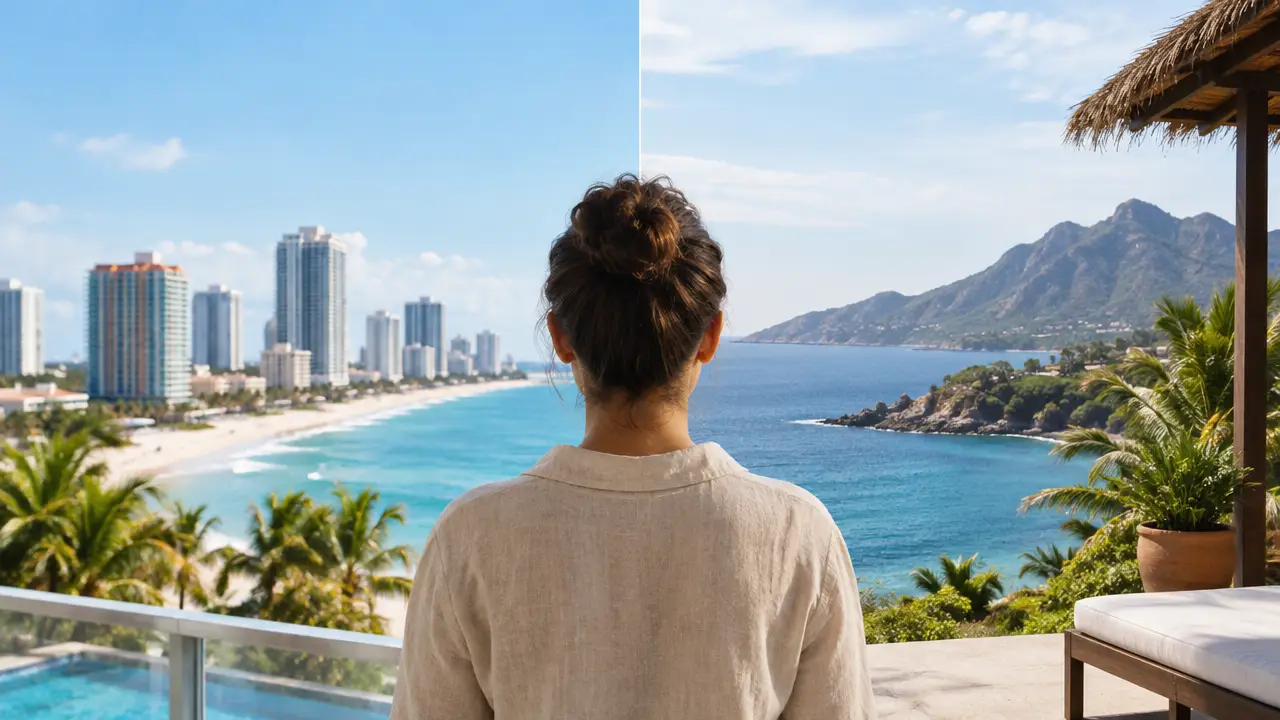
Florida is the residential addiction treatment capital of the United States. The Sunshine State is home to more rehabilitation facilities per capita than any other state, concentrated in areas like South Florida (Palm Beach, Fort Lauderdale, Boca Raton), with a treatment industry that generates billions of dollars annually. When people think of going to rehab, Florida — with its warm climate, coastal setting, and dense treatment infrastructure — is often the first destination that comes to mind.
The comparison with Mexico is compelling for a simple reason: the same warm climate and coastal wellness environment that makes Florida attractive for recovery is available in Mexico at a fraction of the cost, with comparable or better clinical quality for CARF-accredited programs.
COST: THE MAJOR DIFFERENCE
The most immediately significant difference between Florida and Mexico for residential treatment is cost.
Florida residential treatment costs:
Quality residential treatment programs providing 45 days of treatment in Florida — at programs with genuine clinical depth and appropriate accreditation — typically range from $25,000–$60,000+. Luxury Florida programs, particularly in Palm Beach and Boca Raton, regularly run $40,000–$100,000 or more for 30 days.
What drives Florida’s costs:
- High real estate costs in desirable coastal Florida locations.
- Higher labor costs for clinical and support staff in the U.S.
- Overhead, regulatory compliance, and administrative costs of U.S. healthcare operations.
- Insurance billing complexities that add administrative burden (and can also result in partially insurance-funded treatment for patients with good commercial insurance coverage).
Oceánica Mexico costs:
Oceánica’s CARF-accredited residential programs range from approximately $12,500–$13,500 USD for 45 days of treatment in the mood/burnout program, $15,400–$16,400 for 45 days of treatment in the substance use program, and $18,100–$19,100 for the 45-day extended program.
The cost difference:
A patient spending $12,500–$13,500 at Oceánica compared to $30,000–$60,000 for a comparable Florida program is saving $17,000–$47,000 — sufficient to fund months of outpatient aftercare, sober living, continued therapy, or significant financial recovery from the costs of active addiction.
CLINICAL QUALITY COMPARED
The assumption that U.S. programs are automatically better quality than international programs reflects cultural bias rather than clinical evidence. Quality depends on the specific program, not the flag under which it operates.
The key quality indicator: CARF accreditation is recognized internationally. A CARF-accredited program in Mexico has met the same inspected standards as a CARF-accredited program in Florida. Oceánica is CARF-accredited, holding it to the same externally verified clinical standards as accredited Florida facilities.
Florida quality landscape:
Florida’s treatment industry includes excellent programs and — frankly — a substantial number of programs of questionable quality. The state gained notoriety in the 2010s for “patient brokering” scandals in which facilities were paid kickbacks to recruit patients, sometimes without clinical justification. Florida has since enacted regulations to address this, but the quality variability in the Florida market is genuinely wide.
Oceánica’s clinical profile:
- CARF-accredited residential program
- Fully English-speaking clinical team (therapists, physicians, medical technicians)
- 8:1 therapist-to-patient ratio
- 2 individual therapy sessions + 5 group sessions weekly
- 30+ years of experience
- Integrated dual diagnosis treatment
- Individualized treatment planning
The clinical offering at Oceánica matches or exceeds what many mid-range Florida programs provide — while the cost is a fraction.
INSURANCE REALITIES
The insurance picture is one of the most significant practical differences between Florida and Mexico treatment.
Florida insurance coverage:
U.S. residential treatment programs in Florida may be covered — partially — by private insurance, Medicaid, or Medicare (for appropriate presentations). The Mental Health Parity and Addiction Equity Act requires that insurance cover mental health and substance use treatment comparably to medical/surgical benefits. In practice, insurance coverage for residential treatment is highly variable, often covers only a portion of costs, involves preauthorization battles, and may require in-network programs.
The insurance advantage is real but often less significant than it appears: many people with “good” insurance still face substantial out-of-pocket costs after insurance negotiations, and insurance coverage often comes with utilization review that limits the length of stay.
Mexico insurance reality:
Oceánica does not bill U.S. insurance directly. Patients pay out of pocket and receive documentation for potential reimbursement. Some patients with out-of-network benefits may receive partial reimbursement; many do not.
The net comparison: a patient with good insurance coverage at a Florida program might pay $10,000–$20,000 out of pocket after insurance. A patient paying out of pocket at Oceánica pays $12,500–$19,100 with no insurance complexity, no preauthorization battles, and no risk of mid-treatment insurance decisions affecting care. The financial reality is closer than the insurance comparison initially suggests.
CLIMATE & SETTING
Both Florida and Mexico’s Pacific coast offer warm, sunny climates — but the settings differ.
Florida:
- Southeastern coastal setting, Atlantic or Gulf coast.
- Hot and humid in summer; mild in winter.
- Well-developed tourism and lifestyle infrastructure.
- Treatment programs often located in suburban or residential settings in Boca Raton, Delray Beach, Fort Lauderdale, or similar communities.
Mazatlán / Oceánica:
- Pacific coast subtropical climate: warm year-round, lower humidity than Florida summers, over 300 sunny days annually.
- More than 2,500 hours of annual sunshine — comparable to Florida’s sunbelt advantage.
- Rich cultural environment: colonial architecture, local fishing culture, significant historical character distinct from U.S. suburban settings.
- The cultural distinctiveness of Mexico provides the environmental shift that supports recovery in ways that a different U.S. state may not — genuine geographic and cultural distance from the original using environment.
FAMILY & LOGISTICS
Travel logistics for families differ meaningfully between Florida and Mexico.
Florida accessibility:
- Domestic travel within the U.S. — no passport required, familiar logistics.
- Flight connections available from most U.S. cities.
- For patients from the West Coast, Midwest, or Northeast, Florida may require comparable or longer travel than Mexico.
Mexico (Mazatlán) accessibility:
- International travel — passport required.
- Direct flights from multiple U.S. cities (Los Angeles, Phoenix, Houston, and others) with 2-4 hour travel times.
- For patients from the Southwest, West Coast, or Rocky Mountain states, Mazatlán is often closer than Florida.
- A small refundable personal-incidentals deposit is collected at admission; pricing is clear and transparent.
FREQUENTLY ASKED QUESTIONS
Why is rehab in Mexico cheaper than Florida if the quality is comparable?
Lower operational costs: real estate, labor, overhead, and administrative costs are all lower in Mexico than in coastal Florida. CARF accreditation verifies that quality standards are maintained independent of cost.
Does insurance cover Florida rehab but not Mexico?
Generally yes — U.S. insurance doesn’t typically cover international programs. However, Florida insurance coverage is often partial, complex, and subject to utilization review. The net out-of-pocket difference after insurance may be smaller than expected.
Is the clinical quality really comparable?
For CARF-accredited programs, yes. Accreditation verifies clinical standards independent of location. Florida’s treatment industry includes excellent programs but also wide quality variability. Oceánica’s CARF accreditation, fully English-speaking clinical team, and 30+ years of experience provide a clinical foundation comparable to mid-to-high range Florida programs at a substantially lower cost.
What are the practical travel differences?
Florida doesn’t require a passport; Mexico does. For many western U.S. patients, Mazatlán is no further by flight than Florida — sometimes closer. Family visit logistics are manageable from most of the U.S.
Recommended Reading
- Rehab in Mexico vs USA
- Medical Tourism for Rehab in Mexico
- How Much Does Rehab in the U.S. Cost?
- Services and Programs at Oceánica
EXTERNAL REFERENCE LINKS
- CARF International — Accreditation Search
- SAMHSA — Treatment Locator
- National Institute on Drug Abuse — Treatment
- Oceánica Conecta
Oceánica is a CARF-accredited residential treatment center in Mazatlán, Mexico. Programs from $12,500 USD. Oceánica does not bill U.S. insurance directly. A small refundable deposit is collected at admission. Call (213) 527-3377 or visit oceanica-usa.com.