
This article is informational and not medical advice. SAD requires assessment by a qualified professional. All treatment decisions, including medication and light therapy protocols, are made by qualified clinicians.
Feeling a bit lower in the dark winter months is so common that it’s become a cultural cliché. But seasonal affective disorder — SAD — is not the winter blues. It’s a clinically recognized subtype of major depressive disorder with defined diagnostic criteria, identifiable neurobiology, and evidence-based treatments. For those who experience it, SAD can produce the full range of depressive symptoms — profound fatigue, difficulty functioning, changes in sleep and appetite, and in severe cases, significant impairment — with a predictable seasonal pattern that returns year after year.
Understanding the difference between ordinary seasonal mood dip and true SAD, and knowing when treatment is warranted, matters for people and families dealing with this genuinely debilitating condition.
DSM-5 CRITERIA FOR SAD
In the DSM-5, seasonal affective disorder is not listed as a separate diagnosis but as a “seasonal pattern specifier” that can be applied to major depressive disorder or bipolar disorder.
The criteria for the seasonal pattern specifier include:
- A regular temporal relationship between the onset of major depressive episodes and a particular time of year (e.g., fall or winter).
- Full remissions (or a switch from depression to hypomania/mania) at a characteristic time of year (e.g., spring/summer).
- Two major depressive episodes demonstrating the seasonal pattern in the last two years (with no non-seasonal episodes during that time).
- Seasonal depressive episodes substantially outnumber lifetime non-seasonal episodes.
The most common pattern is fall-onset depression with spring remission, corresponding to reduced sunlight in northern latitudes. A less common but recognized pattern is summer-onset SAD with winter remission.
Symptoms of the winter-pattern SAD often include:
- Oversleeping (hypersomnia) rather than insomnia — one of the distinguishing features from typical depression.
- Overeating, particularly carbohydrate cravings, and weight gain.
- Low energy, fatigue, and heaviness.
- Loss of interest in activities and social withdrawal.
- Depressed mood, difficulty concentrating, hopelessness.
- These symptoms typically emerge in fall and lift naturally in spring.
The distinction from “winter blues”: Ordinary seasonal mood changes are mild, don’t significantly impair functioning, and don’t meet criteria for major depression. SAD meets the full criteria for a major depressive episode and produces clinically significant impairment.
THE NEUROBIOLOGY
The neurobiology of SAD is reasonably well understood and helps explain both why it occurs and why certain treatments work.
Reduced sunlight and circadian disruption. Less sunlight in fall and winter disrupts circadian rhythms — the body’s internal biological clock. The timing of sleep-wake cycles, cortisol secretion, and other biological rhythms shifts in ways that affect mood.
Serotonin dysregulation. Sunlight affects serotonin transporter activity. In people with SAD, reduced sunlight may cause increased serotonin reuptake — lowering synaptic serotonin and contributing to depressive symptoms. This is the mechanism through which SSRIs are beneficial.
Melatonin. The seasonal change in day length affects melatonin secretion (the hormone signaling darkness and promoting sleep). People with SAD may have altered melatonin patterns that contribute to the circadian disruption.
Vitamin D. Sunlight stimulates vitamin D synthesis, and vitamin D deficiency is associated with depression. Northern latitudes in winter produce insufficient UVB for vitamin D synthesis, contributing to deficiency.
Genetic vulnerability. SAD runs in families, and genetic factors influence individual vulnerability to these seasonal neurobiological shifts.
LIGHT THERAPY EFFECTIVENESS
Light therapy is the first-line treatment for SAD and is notable for its rapid effectiveness — often producing improvement within days to weeks, faster than antidepressant medication. It addresses SAD at its neurobiological root: the reduced sunlight that triggers the seasonal pattern.
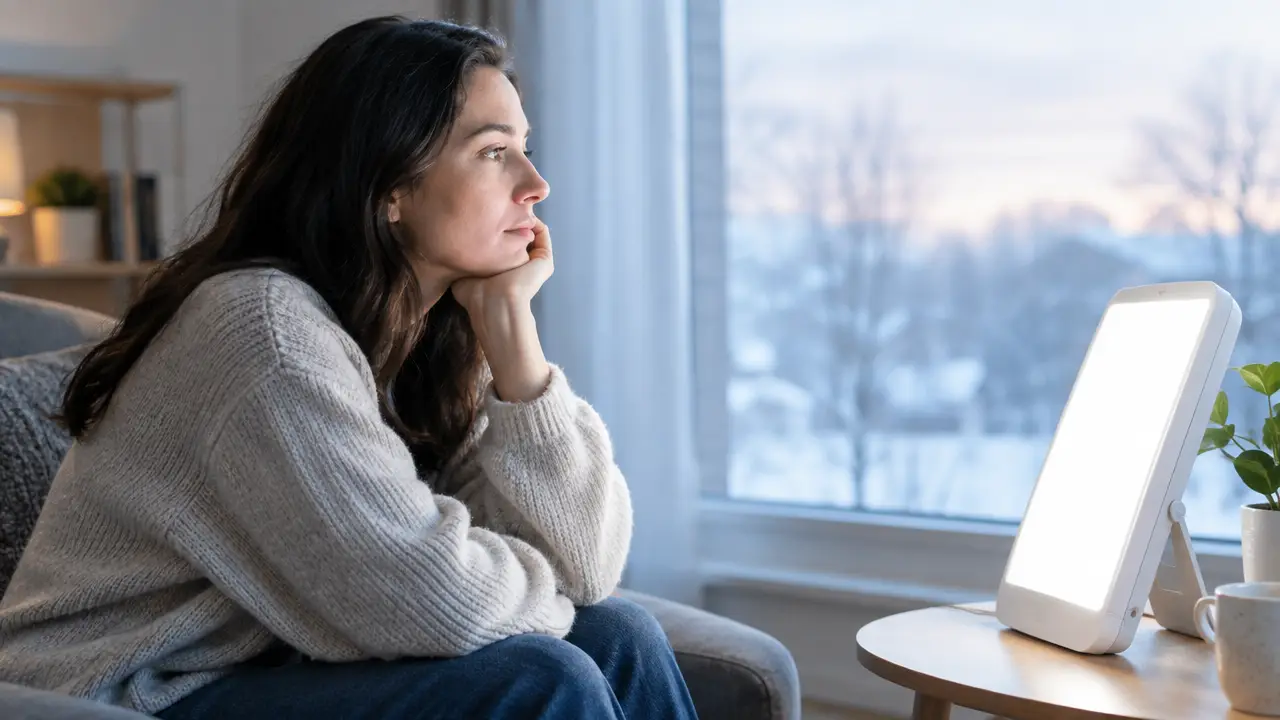
How light therapy works. A light therapy box produces bright light (typically 10,000 lux, significantly brighter than ordinary indoor lighting) that is used for 20–30 minutes each morning. The bright light suppresses morning melatonin and resets the circadian clock, counteracting the effects of reduced winter sunlight.
Evidence for effectiveness. Light therapy has strong evidence from randomized controlled trials for seasonal depression, comparable to antidepressant medication for SAD. It is endorsed by major clinical guidelines.
Practical considerations:
- Morning timing appears most effective, consistent with the circadian mechanism.
- Regular daily use throughout the at-risk season is typically needed.
- Light therapy boxes must produce the appropriate light intensity and filter UV (light therapy for SAD uses visible light, not UV).
- Side effects are generally mild (headache, eye strain, agitation) and manageable.
- Light therapy for bipolar SAD should be used with caution and under medical supervision, as it can trigger mood switching.
All treatment decisions, including light therapy protocols, are appropriate to discuss with a clinician.
WHEN GEOGRAPHIC TREATMENT HELPS
A particularly interesting dimension of SAD treatment — one relevant to Oceánica’s location — is the role of geography and sunlight exposure in recovery.
For some people with SAD, treatment in a sunnier location during the winter months is genuinely beneficial — not as a substitute for clinical treatment, but as a supportive environmental factor. The Mazatlán coast provides abundant sunlight year-round, in contrast to the reduced-light environments of northern U.S. states and Canada where SAD is most prevalent.
At Oceánica, patients with SAD benefit from:
- Sunlight exposure built into the daily schedule — outdoor time, pool access, the coastal environment.
- The warm, light-filled physical environment itself supporting mood regulation.
- Outdoor physical activity — volleyball, soccer, walking — in sunlight, which combines exercise and light exposure.
This is not a curative dimension — clinical treatment (therapy, medication management, light therapy where indicated) remains the foundation. But the geographic and environmental context of a sunny coastal residential program is genuinely relevant for people with seasonal depression and represents a meaningful advantage over residential treatment in northern or indoor-focused settings.
COMPREHENSIVE CARE
For mild to moderate SAD, light therapy, psychotherapy (especially CBT adapted for SAD), and sometimes antidepressant medication are effective outpatient treatments. Residential care becomes relevant when:
- SAD is severe, producing significant impairment that outpatient treatment hasn’t addressed.
- SAD co-occurs with other conditions — particularly bipolar disorder, where careful management of the seasonal pattern is clinically important, or substance use disorder.
- Treatment-resistant seasonal depression requires comprehensive medication reassessment.
When residential care is sought for SAD at Oceánica, the program integrates clinical treatment with the environmental advantages of year-round sunlight and outdoor activity in Mazatlán’s coastal setting.
FREQUENTLY ASKED QUESTIONS
What is seasonal affective disorder?
SAD is a clinically recognized pattern of major depressive episodes that recur seasonally — most commonly in fall and winter with remission in spring and summer. It meets full criteria for major depression and produces significant impairment, distinguishing it from ordinary winter mood dips.
How is SAD different from just feeling down in winter?
SAD meets the full DSM-5 criteria for major depressive episodes with a defined seasonal pattern, produces clinically significant impairment (not just mild low mood), and typically involves specific features like hypersomnia and carbohydrate craving. Ordinary winter mood changes are mild and don’t meet clinical criteria.
Does light therapy actually work?
Yes. Light therapy has strong evidence from randomized controlled trials, comparable to antidepressant medication for SAD, and is a first-line treatment. It works by resetting the circadian clock through bright light exposure in the morning. Results often appear within days to weeks.
Why might residential treatment in Mexico help with seasonal depression?
The year-round sunlight of Mazatlán provides the environmental light exposure that reduced northern winter sunlight denies — while clinical treatment addresses the mood disorder comprehensively. It combines clinical care with a genuinely therapeutic environment for seasonal depression.
Recommended Reading
- Depression Treatment in Mexico: Residential Care That Works
- Mood Disorder Treatment in Mexico: 45 Days of Treatment in an Intensive Program
- Major Depressive Disorder: Symptoms, Causes, Treatment
- Services and Programs at Oceánica
EXTERNAL REFERENCE LINKS
Oceánica is a CARF-accredited residential treatment center in Mazatlán, Mexico, providing comprehensive treatment for seasonal affective disorder and related mood conditions. This article is informational and not medical advice. All medication and treatment decisions are made by qualified clinical staff. Call (213) 527-3377 or visit oceanica-usa.com.